

$ cat README.md
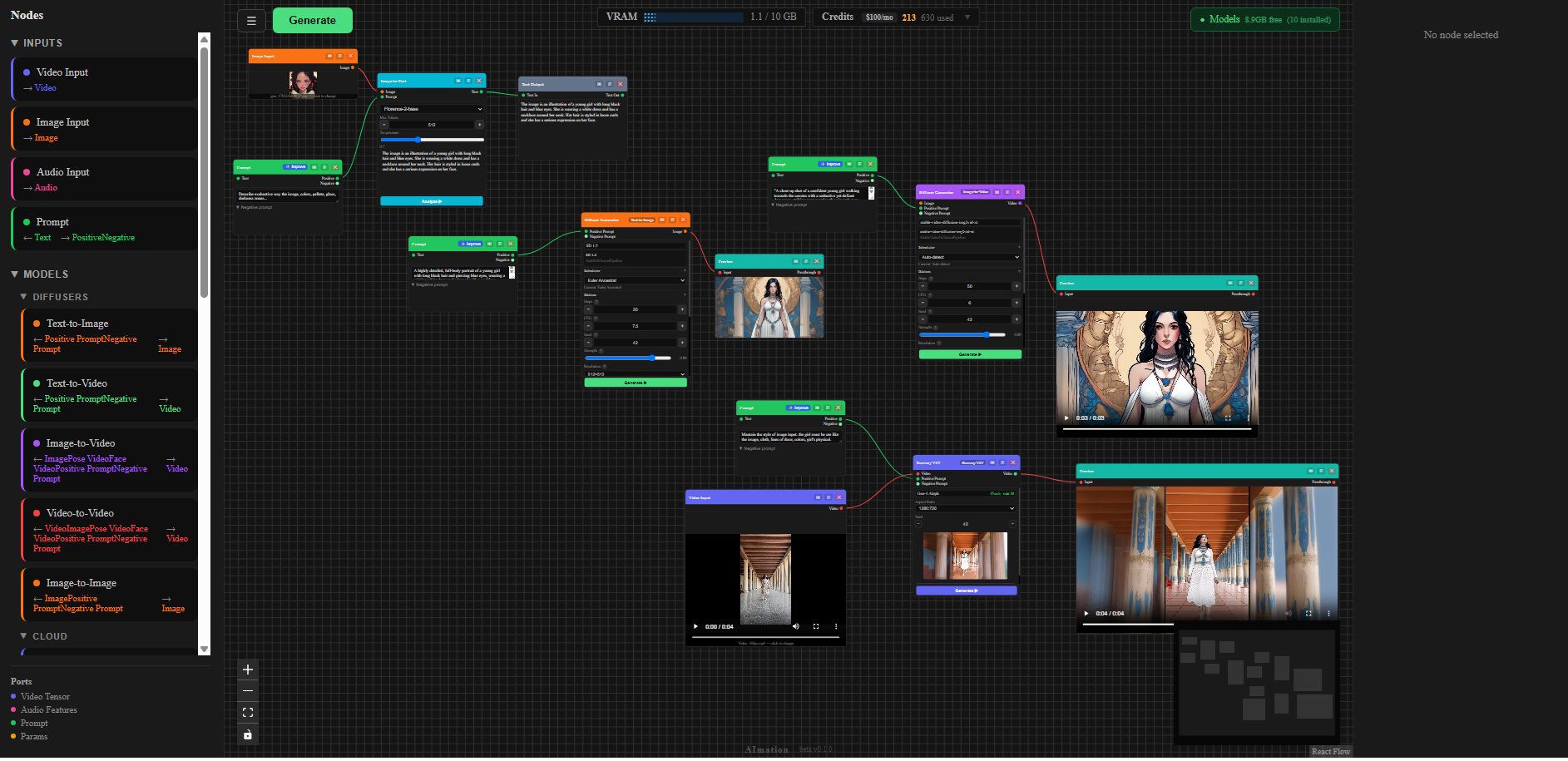
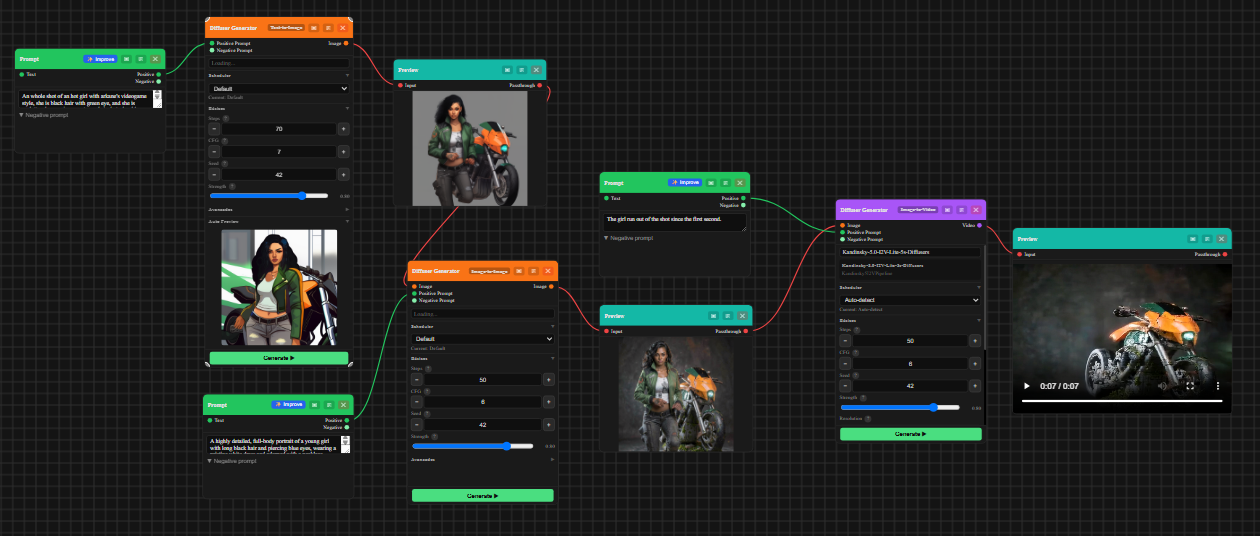
AImation is a desktop-first node workflow for generating animations and video from image, video, and prompt inputs. You build a graph of connected nodes — an input video, a prompt, a generation step, sampling parameters — and the engine renders a new animation out of it.
Local generation runs through diffusers; cloud adapters cover Kling, Runway, and Seedance. The shell is Tauri (local file access), the editor is React + React Flow, and the brain is a FastAPI sidecar in Python.
$ ls media/
$ ls src/
$ node --list
Plus generator and adapter nodes: Text-to-Image, Image-to-Video, Video-to-Video, LLM generator, VLM, ControlNet, LoRA, and CV task processors.
$ cat generation.md
Local — diffusers runners
- LTX-Video 2B (phase 1 target)
- Wan 2.2
- CogVideoX
- GGUF quantized models
- FP8 + CPU-offloaded text encoder
Cloud — API adapters
- Kling
- Runway
- Seedance
- Credential manager
- Credit manager
Phase 1 runs LTX-Video 2B locally on an RTX 3080 with VRAM management: center-crop + resize, flow-matching denoising loop, and async task queue with progress polling.
$ cat architecture.md
- src/backend — FastAPI sidecar: API routes, config, models, generator runners, task queue, model registry, credit & credential managers
- src/frontend — React + React Flow node editor
- providers — cloud adapters + local runners
- workers — background execution
- specs — SpecSecOps phase specs
$ cat methodology.md
Built with SpecSecOps — Spec-Driven Development with DevSecOps integrated from day one. Every change follows Explore → Propose → Spec → Design → Tasks → Apply → Verify → Archive, with adversarial review on every PR and tests as a hard requirement.
- Desktop-first. Tauri shell, local file access, sidecar backend.
- Specs before code. No implementation without an approved spec.
- Tests are mandatory. No test == incomplete task.
- Adversarial review before merge. Every PR gets a Risk + Reliability review.
- Security in every phase. Not a separate step.
$ git status